The Unshakable Second: How Vienna's Self-Stabilizing Nuclear Clock Rewrites Timekeeping
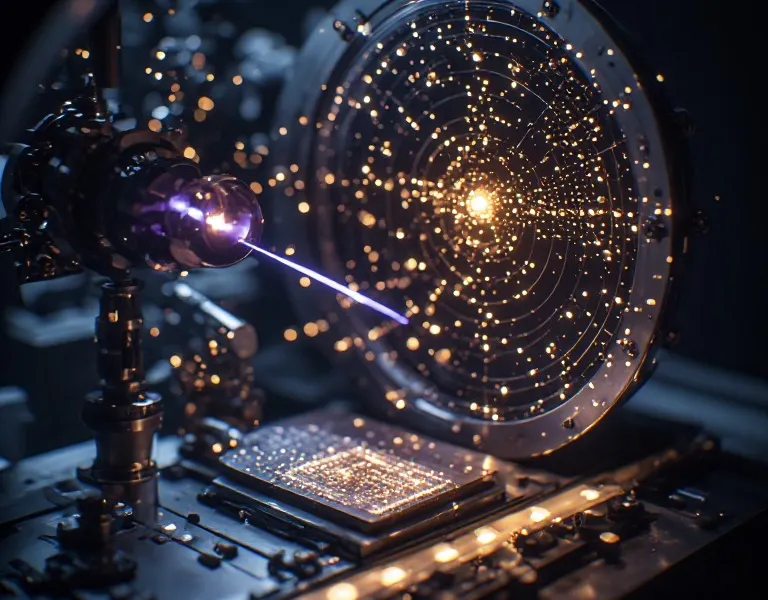
Humanity's most precise timekeepers - standard atomic clocks - rely on the microscopic vibrations of outer electron shells to define a second. However, because electrons sit on the edges of atoms, they remain vulnerable to minor environmental shifts like temperature and stray magnetic fields. This barrier has been shattered by researchers in Vienna who built the world's first self-stabilizing nuclear clock. By targeting the hyper-dense core (nucleus) of a unique Thorium-229 atom using low-energy UV lasers, this clock is practically immune to outside interference. Featuring a built-in feedback loop that self-corrects laser drift in real time, this technological leap is poised to surpass the precision of atomic clocks by orders of magnitude. The innovation will revolutionize modern infrastructure, paving the way for millimeter-accurate GPS, autonomous subsea and urban drone navigation, and independent deep-space travel.
📋 Quick Article Navigation Roadmap
Mid-Post Content Inline
Premium Layout Reserve Space • Status: Framework Mocked
For thousands of years, humanity’s progress has been intrinsically linked to our ability to measure time. We transitioned from tracking the shadows of the sun to constructing mechanical grandfather clocks, and eventually, to engineering the ultra-precise atomic clocks that power our modern digital world. Today, the global coordinate systems, financial trading networks, and GPS satellites that dictate daily life rely entirely on the steady, microscopic vibrations of atoms - usually cesium or strontium - to define the exact length of a single second.
However, science has just breached an entirely new frontier. In a historic laboratory breakthrough in Vienna, an international team of researchers has successfully constructed the world’s first self-stabilizing nuclear clock. This monumental achievement marks a profound shift in quantum physics.
By bypassing the outer shells of the atom and tapping directly into the hyper-protected energy core of the atomic nucleus, this new clock creates a timekeeping system that is practically immune to outside environmental disruption. It is a technological leap that is poised to surpass the precision of standard atomic clocks by orders of magnitude, forever altering global navigation, deep-space exploration, and our fundamental understanding of the universe.
🏛️ 1. Piercing the Nucleus: The Quantum Leap Past Atomic Clocks
To appreciate why a nuclear clock is such a revolutionary milestone, we must first understand how our current gold-standard timekeepers operate. Modern atomic clocks measure time by targeting an atom’s electrons. Scientists blast lasers at an atom, causing its outer electrons to jump back and forth between different energy states. This jumping action behaves exactly like an ultra-fast quantum pendulum. By counting these exact oscillations - 9,192,631,770 times per second for a cesium atom - computers define the absolute legal duration of a standard second.
While atomic clocks are incredibly accurate (losing only one second every few billion years), they possess a fundamental vulnerability:
- Environmental Sensitivity: Because electrons sit on the outermost edges of an atom, they are highly exposed to the chaotic background noise of the universe.
- Stray Field Disruption: Minor changes in ambient temperature, stray magnetic forces, or ambient electrical fields can subtly warp electron behavior.
- Complex Shielding Needs: To maintain their accuracy, modern atomic clocks must be housed inside massive, multimillion-dollar laboratory vaults equipped with intense cryogenic cooling networks and vacuum chambers to shield the electrons from the outside world.
Vienna’s nuclear clock shatters this limitation by ignoring the fragile outer electrons entirely. Instead, it targets the atomic nucleus - the dense, tightly bound core at the dead center of the atom. The protons and neutrons inside the nucleus are packed together so tightly that they are virtually untouched by outside magnetic fields, thermal shifts, or electrical interference. Measuring time from the nucleus is the physical equivalent of moving a delicate pendulum clock out of a windy field and placing it deep inside an underground bunker.
🧪 2. The Thorium-229 Breakthrough: Harnessing the Nuclear Thermostat
For decades, building a nuclear clock was considered a mathematical pipe dream. The fundamental problem was energy. To force a typical atomic nucleus to switch energy states so its oscillations could be counted, scientists needed to blast it with high-energy X-rays or gamma rays. The sheer force required would instantly destroy the delicate components of any clock mechanism.
The breakthrough in Vienna succeeded because the researchers targeted a highly specific, exotic isotope: Thorium-229.
Thorium-229 is a unique anomaly in the periodic table. It possesses the lowest internal nuclear excitation energy of any known atom in the universe. Instead of requiring a massive, volatile particle accelerator to trigger its nuclear pendulum, Thorium-229 can be manipulated using relatively low-energy, safe ultraviolet (UV) lasers.
By precisely tuning a specialized UV laser to match the exact natural resonance frequency of the Thorium nucleus, the Vienna team managed to start and stop the nuclear pendulum at will. More importantly, they engineered a self-stabilizing feedback loop. The clock’s internal system continuously monitors its own laser frequencies against the core nuclear response, automatically correcting any minor mathematical drift in real time. The material behaves like a self-correcting thermostat, locking down its own accuracy without requiring external human adjustment or massive room-sized shielding equipment.
🚀 3. Redefining Navigation: GPS Accurate to the Millimeter
The most immediate real-world beneficiary of this self-stabilizing nuclear breakthrough will be global navigation infrastructure. Global Positioning System (GPS) networks do not actually track your physical location; they measure time. When your smartphone attempts to map a driving route, it syncs with a constellation of overhead satellites. Each satellite broadcasts a continuous time-stamped radio signal. By calculating the exact split-second difference between when the signal was sent and when your phone received it, a processor determines your precise coordinates on Earth.
Because radio signals travel at the speed of light, even a tiny timing error of one billionth of a second can throw off a GPS location reading by a few feet.
As society transitions toward fully automated transportation and intricate robotics, legacy atomic satellite clocks are reaching their practical limits. Self-stabilizing nuclear clocks will completely revolutionize this spatial matrix:
- Millimeter Position Tracking: Upgrading global navigation satellites with nuclear clocks will shrink GPS positioning margins from meters down to fractions of a millimeter.
- Autonomous Vehicle Safety: Self-driving vehicles, commercial drones, and urban air taxis will be able to navigate dense, foggy city streets and tight underground tunnels with total spatial awareness, drastically cutting down on collisions.
- Safe Subsea Navigation: Because nuclear clocks are entirely unaffected by extreme pressure and magnetic anomalies, deep-sea submarines and underwater research vessels can map the ocean floor with absolute precision without needing to surface for satellite re-calibration.
🛰️ 4. Deep-Space Logistics: Navigating the Interstellar Highway
Beyond Earthly navigation, the self-stabilizing nature of Vienna’s nuclear clock represents the master key to the future of deep-space exploration and interplanetary colonization. Current space missions - such as rovers traveling to Mars or probes drifting past outer planets - rely entirely on ground-based atomic clocks situated back on Earth to calculate their trajectories and coordinates.
When a spacecraft sends a telemetry signal back to Earth, it can take minutes or hours for the data to travel across the solar system, be processed by a laboratory clock, and return with course corrections.
For an astronaut crew landing a vehicle on a distant moon or navigating a chaotic asteroid belt, waiting hours for a steering calculation is a recipe for disaster. A spaceship needs an on-board clock that can calculate trajectories autonomously in real time.
Because Vienna’s nuclear clock is self-stabilizing and lacks the massive, fragile cooling systems required by legacy atomic clocks, it can be shrunk down into a compact, durable instrument package fit for spaceflight. An onboard nuclear clock will allow future starships to map their own positions relative to distant cosmic pulsars instantly. It transforms deep-space travel from a slow, Earth-dependent guessing game into an entirely autonomous, self-navigating journey across the interstellar highway.
👥 5. Lifelong Impact: How Nuclear Precision Shapes Every Generation
The shift from the atomic era to the nuclear timekeeping paradigm will quietly alter the foundations of education, enterprise efficiency, and daily security for all age groups across global society.
The Digital Vanguard (Gen Z and Gen Alpha)
For younger generations entering university physics programs or starting high-tech engineering careers, Vienna’s breakthrough completely reframes the science textbook. They will be the first generation to design technologies that operate beyond the atomic scale. They will leverage nuclear precision to build decentralized internet grids that can process billions of international financial micro-transactions a second without experiencing a single millisecond of lag or network desynchronization.
The Economic Core (Millennials and Gen X)
Working professionals, data network administrators, and logistics leaders will experience a massive leap in operational security and infrastructure stability. Cloud computing data hubs, telecommunications networks, and national power grids rely on absolute timing synchronization to prevent data collisions and blackouts. The un-disruptible nature of self-stabilizing nuclear clocks will provide an ironclad safeguard against catastrophic network dropouts, protecting corporate assets and digital workflows from unexpected downtime.
The Elder Generation (Baby Boomers)
For older adults, the long-term benefits of this physics breakthrough will manifest in national safety and critical resource security. Modern defense grids, automated early-warning weather systems, and seismic monitoring networks rely on hyper-precise timing to detect subtle environmental anomalies. Nuclear clocks will allow scientists to map minute tectonic movements and atmospheric pressure shifts with unprecedented accuracy, leading to significantly faster earthquake and tsunami warnings that save lives.
📊 The Evolution of Chronological Technology
The creation of the self-stabilizing nuclear clock expands humanity’s mastery of time measurement into the deepest core of physical matter. The table below outlines how this milestone transforms the timekeeping landscape.
| Era of Timekeeping | Core Oscillating Mechanism | Primary Environmental Weakness | Technological Milestone |
|---|---|---|---|
| Mechanical & Quartz | Physical swinging pendulums or vibrating quartz crystals. | Highly vulnerable to physical movement, gravity, friction, and wear. | Powered the industrial revolution and early consumer electronics. |
| Standard Atomic | Outer electron shells jumping energy states via standard lasers. | Vulnerable to stray magnetic fields, thermal shifts, and electric fields. | Enabled global GPS systems, the modern internet, and cellular networks. |
| Nuclear (Vienna Breakthrough) | Protons and neutrons oscillating inside a Thorium-229 nucleus. | Virtually immune to outside fields due to extreme nuclear density. | Paves the way for millimeter GPS, autonomous space flight, and dark matter research. |
🏁 Conclusion: Cultivating an Unshakable Temporal Future
Ultimately, the successful construction of a self-stabilizing nuclear clock proves that the search for scientific precision is an ever-evolving journey. By looking past the outer electron clouds of the atom and unlocking the protected chamber of the atomic nucleus, researchers in Vienna have provided humanity with a chronological anchor that cannot be shaken by the chaotic forces of the outside world.
As this technology leaves specialized physics labs and integrates into global aerospace, telecommunications, and deep-space exploration pipelines, our modern civilization will gain an unprecedented level of structural stability. By understanding these technological shifts today, global citizens of every generation can prepare for a future anchored by a clock that never drifts, never falters, and keeps time in perfect harmony with the fundamental fabric of the universe.
Disclaimer: The articles on this website are created for informational and educational purposes with the assistance of artificial intelligence (AI) technologies. While our editorial team reviews, edits, and fact-checks all content to ensure maximum accuracy, Thank Wisdom and affiliates makes no warranties or representations regarding the completeness, reliability, or absolute accuracy of the information provided. Readers should consult relevant professionals before making decisions based on this content.