The Shifting Crust: How Thawing Permafrost and Feedback Loops are Redrawing Earth's Geography
The article examines a major shift in climate tracking highlighted by the MIT Technology Review, where rising greenhouse gas levels are rapidly thawing sub-Arctic permafrost, triggering large-scale landslides and intensifying debates over climate model feedback loops. Grounded in soil mechanics, the piece explains how the melting of subterranean 'pore ice' neutralizes friction, causing catastrophic retrogressive thaw slumps and high-speed mud flows. This physical collapse unlocks the planet's ultimate carbon megabank - which stores 1,500 billion tonnes of organic matter - unleashing massive plumes of carbon dioxide and methane. The text details the current high-stakes division within the computational climate modeling community: one faction viewing this linearly as a manageable regional variable, and another warning that current grid models smooth over explosive, localized non-linear tipping cascades. Finally, it outlines the unique socio-economic and logistical realities this shifting crust imposes across Gen Z, Millennials, and Baby Boomers.
📋 Quick Article Navigation Roadmap
Mid-Post Content Inline
Premium Layout Reserve Space • Status: Framework Mocked
Human civilization has always treated the ground beneath its feet as a symbol of absolute permanence. We build cities on rock, trace borders across mountain ranges, and count on frozen terrain to remain frozen. In the global narrative, climate change has long been visualized as an atmospheric or maritime threat - rising sea levels swallow shorelines, while intensifying heatwaves scorch agricultural plains.
However, deep within the subterranean layers of the planet’s sub-Arctic regions, an invisible, structural transformation is occurring. The solid foundation upon which vast ecosystems and human infrastructure are built is losing its structural integrity.
Recent scientific reports highlighted by the MIT Technology Review emphasize a dangerous nexus of surging greenhouse gas concentrations, rapidly thawing permafrost triggering large-scale geographical landslides, and intense debates over climate model feedback loops. We are no longer observing a simple, linear increase in air temperatures. Instead, we are entering a phase where the Earth’s crust itself is destabilizing, shifting climate tracking away from straightforward atmospheric monitoring into a highly complex, non-linear geological crisis.
🏔️ 1. Geotechnical Collapse: The Anatomy of Subterranean Thawing
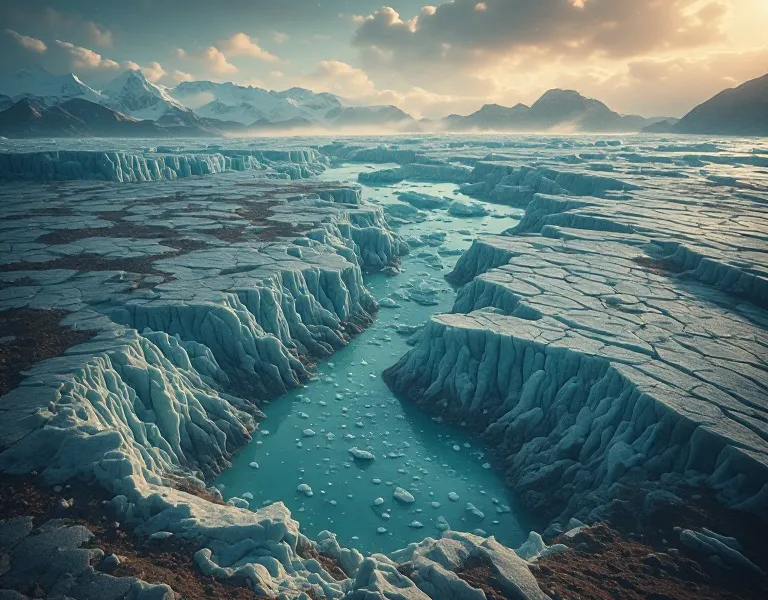
To understand why thawing permafrost can trigger sudden, large-scale landslides, we must examine the geotechnical engineering of frozen soil. Permafrost is not merely cold dirt; it is a complex, hyper-stable matrix of rock, sediment, and organic matter bound together by massive networks of crystalline “pore ice.” This ice acts as a natural cement, lending structural rigidity to steep hillsides, mountain peaks, and river basins across Siberia, Alaska, and Northern Canada.
When atmospheric greenhouse gas levels surge, they trap intense thermal energy in the lower atmosphere, driving deep subterranean warming. As this pore ice melts, the structural physics of the soil undergoes an immediate inversion:
- The Loss of Effective Stress: In soil mechanics, when pore ice transitions into liquid water, the volume change creates immense internal fluid pressure. This internal fluid pressure pushes individual soil particles apart, completely neutralizing the friction that holds a hillside together.
- Retrogressive Thaw Slumps: Unlike a traditional rockslide triggered by a brief earthquake, permafrost collapse often manifests as a slow-burning geological disaster known as a retrogressive thaw slump. A hillside begins to cave in on itself, exposing deeper layers of ice to the warm air, causing a self-reinforcing, ongoing collapse that can swallow entire valleys over months.
- The Liquid Soil Phenomenon: Once the ice completely liquefies, dense hillsides turn into viscous mud rivers. These high-speed mud flows tear through valleys, blocking vital rivers, destroying industrial transit corridors, and altering regional geography in a single afternoon.
🏭 2. The Carbon Megabank: Quantifying the Atmospheric Influx
The physical collapse of the sub-Arctic landscape is only the visible symptom of a much more significant, atmospheric threat. Permafrost functions as the planet’s ultimate subterranean carbon megabank. For hundreds of thousands of years, these frozen soils have acted as a massive cold-storage vault, trapping the decayed remnants of ancient plants, roots, and animal matter.
Scientists estimate that the global permafrost zone holds approximately 1,500 billion tonnes of organic carbon—a volume nearly double the total amount of carbon currently circulating in Earth’s entire atmosphere. As the structural matrix of this terrain breaks down during landslides and slumps, the vault doors are thrown wide open:
- The Microbial Awakening: The moment permafrost thaws, ancient organic matter is exposed to modern soil microbes. These microbes wake up from an evolutionary slumber, consuming the organic matter and outgassing massive plumes of carbon dioxide ((CO_{2})) and methane ((CH_{4})).
- The Methane Multiplier: If the soil collapses into a waterlogged environment, such as a newly formed thermokarst lake or a mudslide basin, microbes operate in an anaerobic (oxygen-poor) environment. This causes them to produce methane—a greenhouse gas with a short-term heat-trapping potency dozens of times higher than (CO_{2}).
- The Non-Human Footprint: This massive outgassing functions as a completely decentralized, natural exhaust pipe. It operates independently of human industrial activity, rendering traditional emission-reduction policies increasingly difficult to project accurately.
🎛️ 3. The Great Feedback Debate: Inside the Climate Modeling Matrix
This intersection of melting terrain and rising gases has sparked an intense, high-stakes debate within the global climate modeling community. As reported by the MIT Technology Review, the core controversy centers on how accurately our current supercomputing models can capture these complex, non-linear feedback loops.
Historically, global climate models treated carbon emissions as a one-way street: humans burn fossil fuels, atmospheric temperatures rise, and the planet gets warmer. But a feedback loop introduces a circular, self-reinforcing dynamic: human emissions cause warming, the warming melts permafrost, the melting permafrost releases natural greenhouse gases, which in turn drive further warming.
The debate among top-tier computational climate scientists is divided into two distinct schools of thought:
The Linear Baseline View
Some modeling factions argue that while permafrost outgassing is deeply concerning, it remains a regional variable that can be managed within existing linear safety parameters. They contend that the bulk of global warming is still heavily dictated by direct human industrial output, meaning that immediate fossil-fuel mitigation remains an effective lever to stabilize global temperatures before natural feedbacks spin out of control.
The Non-Linear Cascade View
Conversely, a growing coalition of non-linear system dynamics experts warns that current computational models are dangerously underestimating the speed of these feedbacks. Because large-scale geological landslides and micro-bacterial outgassing happen at highly localized scales, global climate models - which view the Earth in massive, multi-kilometre grids - frequently smooth over these sudden, explosive tipping points. If these localized cascades occur simultaneously across the sub-Arctic, they risk pushing the entire planetary climate system into a self-sustaining warming loop that human engineering cannot interrupt.
👥 4. Generational Realities: How a Shifting Crust Alters Life on Earth
The collapse of the traditional, slow-moving climate timeline means that the geotechnical and atmospheric shocks of permafrost thaw are actively reshaping the socioeconomic realities of every generation alive today.
The Digital Vanguard (Gen Z and Gen Alpha)
- Reimagining Earth Tracking: For younger generations, studying the environment is transforming from an observational science into an intense big-data discipline. Careers are pivoting toward deployment of autonomous drone swarms, satellite radar mapping, and AI-driven subterranean sensors designed to predict landslide hazards in real time.
- The Interdisciplinary Landscape: Young professionals are entering a job market where geologists, data scientists, and climate attorneys must work in unison to manage the legal and environmental challenges of shifting borders and migrating ecosystems.
The Economic Core (Millennials and Gen X)
- Industrial Supply Chain Volatility: Working professionals are confronting immediate logistical disruptions. Crucial pipelines, roads, and rail tracks built over northern routes are warping as the underlying ground liquefies, threatening global trade routes and demanding multi-billion-dollar infrastructure retrofits.
- The Risk Assessment Shift: Financial compliance officers and asset managers in this demographic are being forced to completely update corporate risk matrices, accounting for natural feedback loops that can suddenly devalue long-term infrastructure investments.
The Elder Generation (Baby Boomers)
- The Preservation of Scientific Legacy: For older adults who built the foundation of modern environmental tracking, witnessing the transition from linear models to volatile, non-linear feedback loops represents a profound scientific shift.
- Direct Philanthropic Targeting: Retirees looking to leave a lasting impact are increasingly bypassing standard conservation efforts, instead directing capital toward high-precision research networks that deploy real-time monitoring across vulnerable polar permafrost frontiers.
The Evolution of Climate Tracking Paradigms
| Tracking Era | Primary Metrics Tracked | Core Modeling Framework | Systemic Environmental Risk |
|---|---|---|---|
| The Linear Atmospheric Era | Industrial smokestack outputs, global car emissions, and surface air temperatures. | Linear, one-way cause and effect (Human emissions directly dictate the speed of warming). | Predictable, steady temperature increases; manageable agricultural adjustments. |
| The Subterranean Inversion Era | Sub-surface permafrost temperature, pore-ice melting rates, and landslide frequencies. | Multi-variable regional feedbacks (Localized terrain collapse accelerates global gas accumulation). | Structural infrastructure failure; sudden localized mudflows; unpredictable natural methane spikes. |
| The Non-Linear Cascade Era | Synchronized planetary feedback loops and structural ecosystem state-shifts. | Fully integrated, non-linear system dynamics (Self-reinforcing cycles bypass human mitigation efforts). | Irreversible geographical reorganization; permanent acceleration of global warming vectors. |
🏁 Conclusion: Building Infrastructure for a Non-Linear World
The geological data amplified by the MIT Technology Review leaves no room for ambiguity. The ground beneath the sub-Arctic is no longer a passive background element in the story of climate change; it has become an active, volatile participant. As surging greenhouse gas levels melt the pore ice that holds the landscape together, the resulting landslides and massive carbon outgassing are rewriting the physical rules of our planet.
Yet, confronting this non-linear shift is not a reason to surrender to climate fatalism. Instead, it serves as an urgent call to upgrade the sophistication of our science and the resilience of our engineering. If our planetary feedback loops are moving into a non-linear phase, our climate models must become hyper-localized, our infrastructure designs must become flexible, and our mitigation strategies must scale to address both human and natural emissions.
By understanding the shifting dynamics of the Earth’s crust today, global citizens across all generations can stop relying on an outdated assumption of permanent geological stability. The timeline has shifted, the ground is moving, and humanity must build a smarter, faster, and more adaptable civilization to ride the waves of a changing world.
Disclaimer: The articles on this website are created for informational and educational purposes with the assistance of artificial intelligence (AI) technologies. While our editorial team reviews, edits, and fact-checks all content to ensure maximum accuracy, Thank Wisdom and affiliates makes no warranties or representations regarding the completeness, reliability, or absolute accuracy of the information provided. Readers should consult relevant professionals before making decisions based on this content.