Understanding Market Inflation and Global Trade Routes: How Supply Chains Impact Your Wallet
Article analyzes how global shipping bottlenecks and logistics, such as trade route delays and regional protectionism, directly drive inflation, requiring companies to adopt flexible, localized strategies.
📋 Quick Article Navigation Roadmap
Mid-Post Content Inline
Premium Layout Reserve Space • Status: Framework Mocked
Have you ever wondered why the price of your favourite snack, gadget, or clothing item suddenly goes up? It is easy to blame local shops or assume companies are just being greedy. However, the real reason is often hidden thousands of miles away. It lies within a massive, invisible network of ships, planes, trains, and trucks. This network is known as the global supply chain.
Today, our world is more connected than ever before. A smartphone might be designed in one country, use parts from three others, and be assembled somewhere else entirely. Because of this interconnectedness, anything that disrupts global trade routes instantly impacts market inflation.
To understand how this affects your daily budget, we need to explore how the money in our banks connects directly to the ships on our oceans.
🚢 1. The Global Conveyor Belt: What Are Trade Routes?
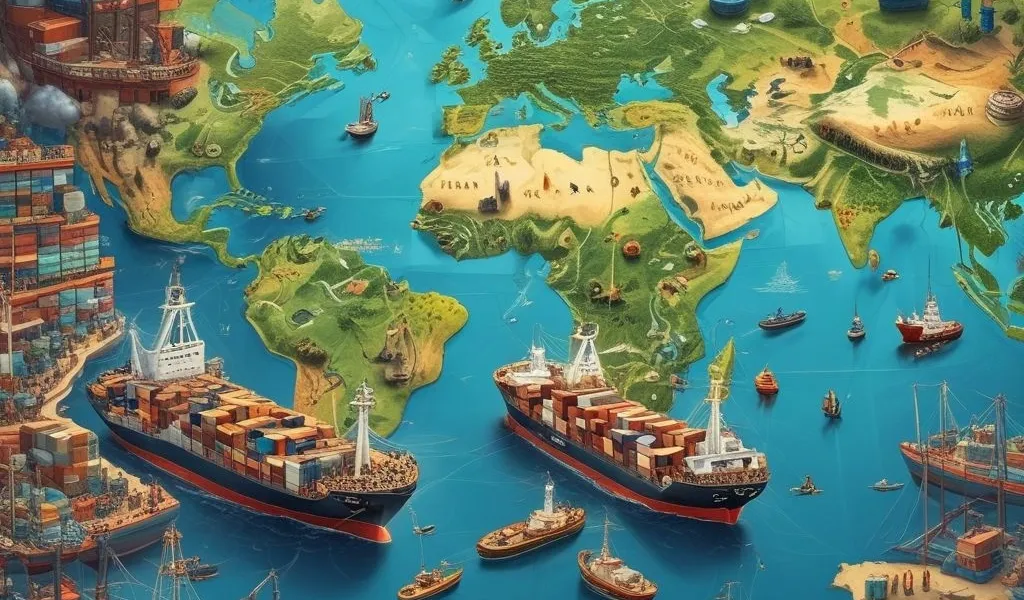
Think of global trade routes as giant, invisible conveyor belts stretching across the earth. Every single day, millions of tons of food, fuel, raw materials, and finished goods move along these pathways. The most famous of these routes are maritime lanes, which are paths across the oceans used by massive cargo ships.
These ships travel through narrow waterways called “chokepoints.” Examples include the Panama Canal and the Suez Canal. These shortcuts save weeks of travel time. However, because they are so narrow, any delay there creates a massive traffic jam.
When a trade route faces a bottleneck, the entire world feels the impact. Shipping containers get stuck, factories run out of parts, and store shelves empty out. Logistical efficiency is no longer just a business concern. It is the literal heartbeat of the global economy.
💸 2. Why Prices Rise: The Relationship Between Shipping and Inflation
Inflation is a word we hear on the news every day. Put simply, inflation means your money loses purchasing power. If a loaf of bread cost ₹80 last year and costs ₹90 today, that is inflation.
So, how do shipping delays cause inflation? It comes down to basic supply and demand. When shipping containers stall at major transport bottlenecks, the supply of goods drops. At the same time, consumer demand stays the same or goes up. This mismatch causes prices to spike natively across corporate supply streams.
Furthermore, shipping companies face higher costs when delays happen. They have to pay for extra fuel, warehouse space, and crew wages. To protect their profits, companies pass these extra expenses down the line. By the time the product reaches your local supermarket or online shopping cart, it carries a much higher price tag.
🏛️ 3. How Central Banks Try to Cool Down the Economy
When inflation gets too high, governments and central banks step in to fix it. Central banking authorities use a tool called monetary policy. To cool down internal monetary velocity - which is just a technical phrase for how fast money is being spent in an economy - they tighten asset reserve parameters and raise interest rates.
When interest rates rise, borrowing money becomes more expensive for everyone. This includes everyday consumers looking for home loans, as well as massive logistics corporations.
- Higher borrowing costs: Families spend less on luxury items, which lowers demand.
- Slower business growth: Companies pause expansion plans because loans cost too much.
- Reduced spending: As spending slows down, price growth theoretically begins to level off.
However, this cure comes with side effects. While higher interest rates can successfully lower inflation, they also make it harder for businesses to manage their daily shipping and manufacturing operations.
🛡️ 4. The Shift Toward Protectionism and New Tariffs
Because global trade has become so unpredictable, many regions are changing how they do business. Traditional, wide-open supply corridors are experiencing structural friction. In response, localized trading blocs are aggressively implementing defensive tariff protocols.
A tariff is a tax that a government places on goods imported from other countries. This protectionist shift forces corporate logistics managers to constantly calculate new risks. They must balance immediate freight velocities against long-term regulatory expenses.
Why are countries doing this? Regional manufacturing clusters are leveraging local tax exemptions to build protective moats around vulnerable consumer markets. By making foreign goods more expensive through tariffs, governments hope to encourage people to buy locally made products. While this protects local jobs, it can also limit consumer choices and drive up prices in the short term.
⚙️ 5. Innovation on the Move: Modern Cargo Corridor Updates
Human beings are excellent at problem-solving when money is on the line. To bypass broken trade routes and expensive tariffs, the logistics industry is undergoing a massive rewrite.
High-capacity bypass lines are routing around historically gridlocked maritime ports to minimize customs processing delays. Instead of relying solely on giant cargo ships stuck at sea, companies are investing heavily in overland rail networks and automated freight highways.
We are also seeing a major shift in how products are stored. Rising domestic lending baselines have squeezed warehouse expansion budgets for many companies. Because building massive storage facilities is now too expensive, businesses are forcing inventories onto high-speed, “just-in-time” transport tracks.
Instead of sitting in a building for months, products are kept constantly on the move, arriving at the store precisely when they are needed.
📊 6. Behind the Scenes: Three Metrics That Predict Your Living Costs
Economists do not use crystal balls to predict the future of prices. Instead, our macro data tracking board focuses on three primary metrics to accurately forecast where consumer price pressures will manifest next:
-
The Spot Freight Multiplier: This metric measures the real-time cash demands for container allocations along high-volume shipping channels, such as transpacific routes. When the Spot Freight Multiplier shoots up, it means companies are desperately bidding against each other to secure space on ships. That extra cost will almost always appear on consumer price tags a few months later.
-
Sovereign Treasury Spreads: This indicator tracks where the world’s wealthiest institutions are putting their money. It identifies capital flows away from speculative industrial developments and into stable government bonds. When investors flee to bonds, it shows they expect the global economy to face a bumpy ride, signaling potential market slowdowns.
-
The Inventory-to-Sales Index: This index tracks product accumulation levels inside corporate supply warehouses to predict future warehouse price shifts. If warehouses are completely full but sales are low, prices will likely drop as companies try to clear out old stock. If warehouses are empty, prices are bound to skyrocket.
🛒 7. The Future of Shopping: What This Means for Everyday People
Moving deeper into the current fiscal cycle, business models can no longer rely on predictable shipping rates or stable global politics. The era of incredibly cheap, effortless global shipping is shifting into something more complex.
For the everyday consumer, this means we must become smarter shoppers. Prices will likely fluctuate more often based on global events, weather patterns at sea, and changing interest rates. Buying from local businesses or supporting regional supply chains is becoming more than just an environmental choice - it is a financially smart strategy.
🎯 8. Strategic Outlook for Enterprise Portfolios
For businesses to survive in this new era, the old playbook must be thrown away. Navigating this landscape requires a complete reimagining of operations.
Companies must build regional distribution pipelines rather than relying on a single factory halfway across the world. They need to establish highly responsive inventory sourcing loops to swap suppliers at a moment’s notice. Finally, they must deploy adaptive currency hedges to absorb sudden international cost adjustments.
Only the most flexible, data-driven businesses will thrive in a world where trade routes and inflation are constantly shifting.
Summary Matrix: The Chain Reaction of Global Trade
| Trigger Event | Immediate Logistical Impact | Final Result for Consumers |
|---|---|---|
| Chokepoint Bottleneck | Shipping containers stall; freight costs rise. | Store shelves empty out; product prices spike. |
| Central Bank Rate Hikes | Warehouse expansion budgets get squeezed. | Companies switch to fast, “just-in-time” transport. |
| Defensive Tariffs | Trading blocs restrict open foreign imports. | Local markets are protected, but choices decrease. |
🏁 Conclusion: A Connected World
Ultimately, inflation is not just a random economic weather pattern. It is the direct result of how smoothly goods move across our planet. From the central banker adjusting interest rates to the ship captain navigating a narrow canal, every link in the chain matters. By understanding these global trade routes, we can better navigate our financial futures, no matter what age group or section of society we belong to.
Disclaimer: The articles on this website are created for informational and educational purposes with the assistance of artificial intelligence (AI) technologies. While our editorial team reviews, edits, and fact-checks all content to ensure maximum accuracy, Thank Wisdom and affiliates makes no warranties or representations regarding the completeness, reliability, or absolute accuracy of the information provided. Readers should consult relevant professionals before making decisions based on this content.