Cosmic Harmonics: Inside Saturn's Mysterious Decagonal Wave and Earth's Autumn Skies
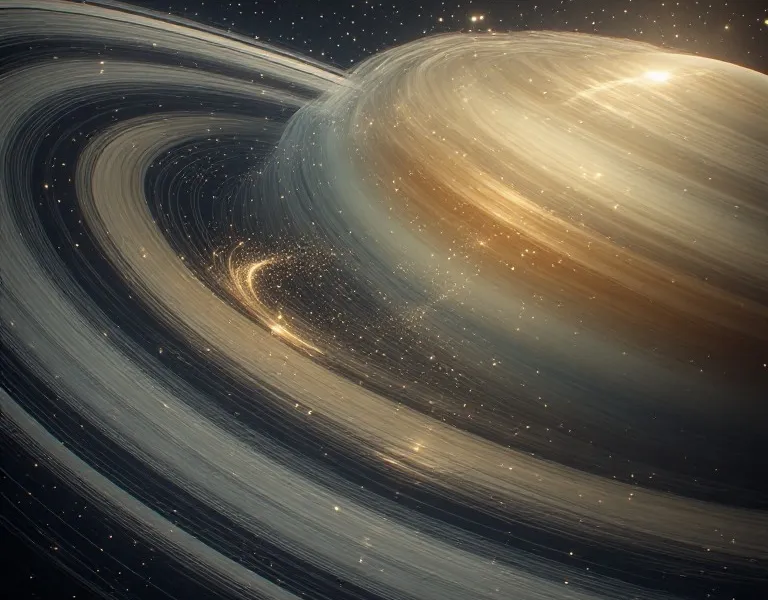
The solar system recently treated humanity to a dual masterclass in cosmic geometry and astronomical alignment. Deep in the outer solar system, NASA's Hubble Space Telescope discovered a rare, 10-sided (decagonal) atmospheric wave circling Saturn's southern pole. Driven by the complex physics of fluid dynamics and Rossby wave resonance, this multi-thousand-kilometer wide storm provides an incredible laboratory for tracking planetary meteorology. Simultaneously, skywatchers on Earth enjoyed a stunning terrestrial display as a brilliant Venus conjunction illuminated the twilight sky directly alongside the deep amber glow of the Harvest Moon. Together, these celestial events highlight the enduring legacy of the Hubble telescope and serve as a universal reminder of the mathematical precision guiding our universe.
📋 Quick Article Navigation Roadmap
Mid-Post Content Inline
Premium Layout Reserve Space • Status: Framework Mocked
Take a moment to look up at the night sky. For millennia, humanity has stared into the dark expanse, seeking patterns, order, and meaning among the stars. While our ancestors mapped constellations, modern astrophysics continuously reveals that the cosmos is far more dynamic, geometric, and awe-inspiring than we ever imagined. The solar system operates like a massive, interconnected clockwork mechanism, occasionally flashing visual spectacles that capture the imaginations of backyard stargazers and elite space agencies alike.
Recently, the heavens delivered a dual cosmic masterclass that bridged the deep outer solar system with our own immediate atmosphere.
In a historic astronomical revelation, NASA’s Hubble Space Telescope captured a rare, 10-sided (decagonal) atmospheric wave churning around Saturn’s southern pole. Back on Earth, skywatchers were treated to a stunning terrestrial view as a brilliant Venus conjunction aligned perfectly alongside the glowing Harvest Moon. Together, these celestial events have ignited a global wave of scientific curiosity, proving that the architecture of our universe is driven by breathtaking geometric precision.
🪐 1. The Decagon of Deep Space: Saturn’s Unprecedented Atmospheric Miracle
For years, planetary scientists have been fascinated by Saturn’s northern hemisphere. The ringed planet famously boasts a massive, permanent six-sided atmospheric jet stream known simply as “The Hexagon.” This colossal storm has been scrutinized by the Voyager and Cassini spacecraft for decades. However, the southern pole remained relatively quiet - until Hubble turned its advanced optical sensors toward Saturn’s southern reaches.
The discovery of the decagonal atmospheric wave has completely rewritten our understanding of gas giant meteorology.
Instead of a smooth, circular vortex, Hubble’s high-resolution imaging revealed a distinct, highly defined 10-sided geometric wave pattern wrapping around the south pole. This structural discovery marks the first time a decagonal wave has been definitively documented in the outer solar system. The sheer scale of the phenomenon is staggering; each side of the decagon spans thousands of kilometers, wide enough to swallow entire terrestrial continents whole.
🧪 2. The Fluid Dynamics of Gas Giants: How Physics Breeds Geometry
How does a chaotic, turbulent gas giant spin random atmospheric winds into a perfect, 10-sided polygon? The secret lies in a complex branch of planetary physics known as fluid dynamics combined with atmospheric wave resonance.
Saturn is not a solid mass; it is a giant ball of hydrogen and helium spinning at a breakneck speed, completing a full day in just over 10 hours. This rapid rotation generates intense, competing jet streams moving at different velocities across different latitudes.
When these fast-moving atmospheric currents rub against each other, they trigger localized fluid instabilities:
- Rossby Wave Resonance: Much like waves crashing on an ocean beach, planetary atmospheres experience massive, winding currents called Rossby waves. Under hyper-specific wind speeds and temperature gradients, these waves can lock into a stable, repeating geometric frequency.
- Harmonic Interference: The decagonal shape is essentially a massive, standing visual harmonic. The wind speeds at Saturn’s southern pole happened to hit the exact mathematical sweet spot required to split the circular storm into ten symmetrical vertices.
This discovery provides engineers and meteorologists with an incredible data laboratory. By studying how Saturn builds perfect geometry out of chaotic storms, scientists can refine fluid dynamic models used to predict intense weather patterns, hurricane formations, and jet stream behavior right here on Earth.
🌕 3. Earthly Spectacles: The Brilliant Venus Conjunction and the Harvest Moon
While the Hubble Space Telescope was capturing geometric anomalies billions of kilometers away, citizens on Earth merely had to step outside their front doors to witness a mesmerizing celestial dance.
The early autumn night sky featured a spectacular Venus conjunction, where the brightest planet in our solar system appeared to drift remarkably close to the Harvest Moon—the full moon closest to the autumnal equinox.
This cosmic alignment served as a beautiful visual bridge for skywatchers globally:
- The Diamond of the Evening Sky: Because Venus is shrouded in highly reflective sulfuric acid clouds, it acts as a colossal cosmic mirror, bouncing sunlight back into the solar system. During the conjunction, Venus blazed like an intense, steady diamond parked just beside the lunar crescent.
- The Golden Harvest Glow: The Harvest Moon is historically famous for its deep orange, amber hue. Because the moon’s orbital angle rises more quickly during this season, it provides farmers and modern observers with prolonged, high-intensity twilight illumination immediately after sunset.
When these two brilliant entities shared the same narrow field of view, it created a stunning visual contrast. The amber radiance of the massive lunar surface paired with the sharp, icy brilliance of Venus offered a breathtaking reminder of our dynamic place within the solar system grid.
🎛️ 4. The Modern Golden Age of Astronomy: Hubble’s Enduring Visual Legacy
The discovery of Saturn’s decagonal wave highlights a massive, ongoing triumph in space exploration technology: the incredible longevity of the Hubble Space Telescope. Launched in 1990, Hubble has spent over three decades orbiting Earth, consistently delivering data-rich imagery that redefines human knowledge.
While newer instruments like the James Webb Space Telescope (JWST) focus heavily on deep infrared look-backs to the dawn of time, Hubble remains the premier guardian of our immediate planetary neighborhood.
Its advanced high-resolution cameras specialize in capturing visible and ultraviolet light spectrums. This allows planetary scientists to continuously track long-term seasonal atmospheric shifts on gas giants like Saturn and Jupiter over decades. Hubble’s ability to detect the subtle, geometric boundaries of the southern decagonal wave proves that this legendary space observatory remains absolutely vital to the global scientific community.
👥 5. Lifelong Impact: How the Wonders of Space Unite Generations
Stargazing and space discovery possess a unique cultural superpower: they break down demographic barriers, sparking authentic wonder and curiosity across all generations of our global society.
The Digital Vanguard (Gen Z and Gen Alpha)
For younger generations, space events are viral catalysts for digital creativity. High-res imagery of Saturn’s decagon and stunning smartphone photos of the Venus conjunction immediately flood platforms like TikTok and Instagram. This instant, visual accessibility turns space science into an interactive playground, inspiring students to pursue careers in astrophysics, aerospace engineering, and computational planetary modeling.
The Economic Core (Millennials and Gen X)
Working professionals and parents leverage these accessible cosmic milestones to step away from daily digital screen fatigue. The predictable alignment of the Harvest Moon and Venus serves as a vital psychological circuit breaker, prompting families to put down their devices, set up backyard telescopes, and share a screen-free moment of awe that fosters deep household conversation.
The Elder Generation (Baby Boomers)
For older adults, planetary discoveries evoke deep nostalgia for the mid-century Space Race era while offering profound perspective on human progress. Witnessing a 30-year-old telescope discover new geometry on Saturn highlights the incredible value of long-term scientific investment. Furthermore, the Harvest Moon carries deep cultural and agricultural meaning for seniors, connecting them to ancestral cycles of growth, harvesting, and community gathering.
📊 Geometric Dynamics Across the Planets
The occurrence of rigid geometric storms across gas giants reveals a fascinating law of planetary physics. The table below outlines how geometry manifests across our solar system.
| Geometric Phenomenon | Primary Location | Key Architectural Driver | Planetary Observation Method |
|---|---|---|---|
| The Northern Hexagon | Saturn’s North Pole | Permanent, six-sided jet stream stabilized by deep internal wind shear. | First mapped by Voyager; continuously tracked by Cassini and JWST. |
| The Southern Decagon | Saturn’s South Pole | Rare, ten-sided transient atmospheric wave generated by Rossby resonance. | Discovered via high-resolution visible-light imaging by Hubble. |
| Polygonal Cyclones | Jupiter’s Polar Regions | Clusters of massive cyclones locking into rigid pentagonal and octagonal arrays. | Photographed in deep detail by the Juno orbital spacecraft. |
🏁 Conclusion: The Unfolding Symphony of the Cosmos
Ultimately, the discovery of Saturn’s decagonal wave and the stunning terrestrial view of the Venus-Harvest Moon conjunction remind us that the universe is never stagnant. From the roaring, mathematically precise jet streams of outer gas giants to the peaceful, cyclical alignments in our own night skies, the cosmos operates on a scale of beautiful, predictable harmony.
By celebrating these structural milestones, global citizens of every age group can expand their perspectives beyond the daily boundaries of Earthly stress. As space exploration technology continues to mature, we can rest assured that the night sky will keep delivering magnificent geometric riddles—inviting us to look up, wonder, and continue our eternal human journey of discovery.
Disclaimer: The articles on this website are created for informational and educational purposes with the assistance of artificial intelligence (AI) technologies. While our editorial team reviews, edits, and fact-checks all content to ensure maximum accuracy, Thank Wisdom and affiliates makes no warranties or representations regarding the completeness, reliability, or absolute accuracy of the information provided. Readers should consult relevant professionals before making decisions based on this content.