History's Warning: What the Fall of the Roman Denarius Teaches Us About Modern Inflation
This article traces the historical collapse of the Roman denarius, showing how the empire's decision to lower the silver purity of its coins to cover debt created the ancient world's worst inflation crisis. It draws direct parallels to modern economies that print paper and digital fiat money to manage mounting debts, offering timeless wealth preservation strategies - like investing in real estate, precious metals, and global diversification - to help readers protect their purchasing power today.
📋 Quick Article Navigation Roadmap
Mid-Post Content Inline
Premium Layout Reserve Space • Status: Framework Mocked
When we open our wallets or look at our digital bank accounts, we rarely think about the physical nature of our money. To most of us, a banknote or a digital balance is simply a tool we use to buy things. We trust that a hundred-unit note today will still hold a similar value tomorrow.
However, history shows that money is a fragile human invention. It only works when people have absolute trust in its stability. When that trust breaks down, entire societies can crumble.
To understand why prices are rising today, we do not actually need to look at modern tech stock markets or complex Wall Street algorithms. Instead, we can look back nearly two thousand years into the past. By tracing historical economic cycles, we can identify modern inflation baselines and discover vital market preservation metrics. The ultimate cautionary tale of currency devaluation lies within the ruins of the Roman Empire.
🪙 1. The Story of the Denarius: The Silver Standard of Rome
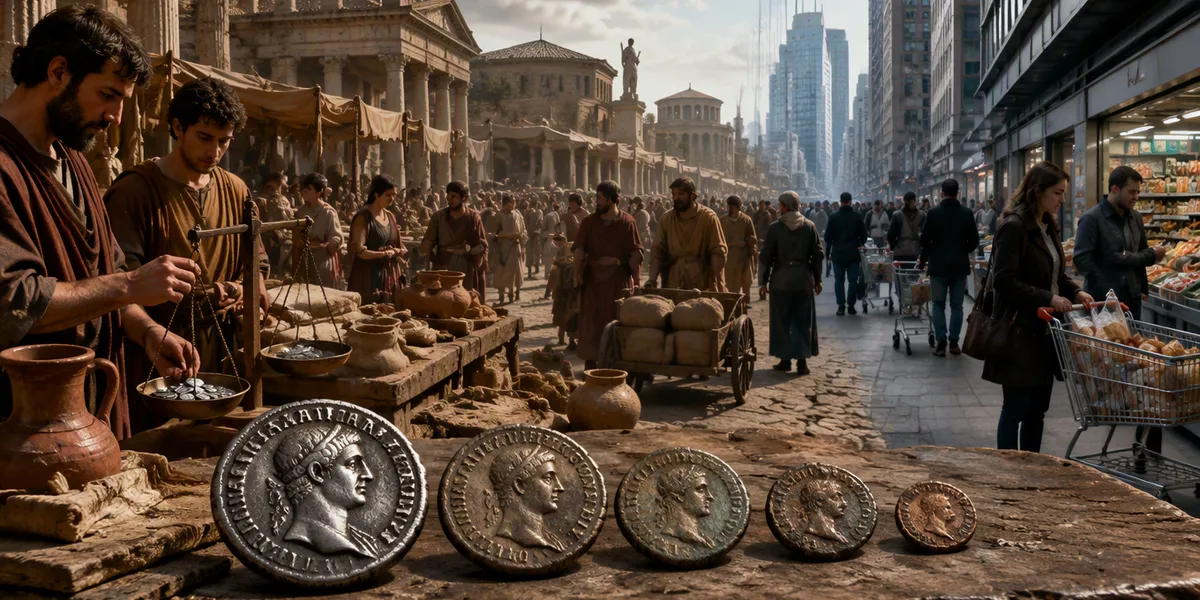
At the height of its power, the Roman Empire ran on a magnificent, uniform financial system. The backbone of this global trading network was a small silver coin known as the denarius. Introduced during the Roman Republic, this single coin allowed merchants from Rome, Egypt, Greece, and Spain to trade with one another effortlessly.
When the denarius was first minted, it was a masterpiece of sound money. It was composed of roughly 95% pure silver.
Because everyone knew the coin contained real, valuable precious metal, the denarius was trusted everywhere. A Roman soldier knew exactly how much food his daily wage could buy, and a merchant knew exactly how many coins to ask for in exchange for a silk robe or a jar of olive oil. This trust created an era of unprecedented economic growth and stability across the Mediterranean world.
📉 2. The Slippery Slope of Devaluation: Slicing the Silver
As the centuries rolled on, the Roman Empire faced massive financial strain. Running a global superpower is an incredibly expensive endeavor. Rome had to fund massive standing armies, build thousands of miles of paved roads, construct giant aqueducts, and pay for lavish public games to keep the population entertained.
Eventually, the empire hit a wall: its structural expenditures far surpassed its true productivity metrics. The government was spending much more money than it was collecting through taxes.
Instead of cutting back on spending or raising taxes - which would have made the emperor highly unpopular - Roman leaders chose a hidden path. They decided to alter the money itself. This process began a foundational framework for studying long-term currency devaluation cycles.
- The trick: The imperial mint would melt down existing silver coins and mix them with cheaper base metals, like copper.
- The illusion: The coins looked exactly the same size and carried the emperor’s face, but they contained less actual precious metal.
- The math: By reducing the silver purity, the emperor could suddenly mint two million coins out of the silver supply that used to only make one million.
💸 3. The Domino Effect: How Diluted Money Sparked Inflation
For a short while, the trick worked perfectly. The Roman government paid its soldiers and contractors with the newly minted, diluted coins. However, you cannot fool an entire market forever.
Merchants quickly noticed that the coins felt lighter and looked slightly duller. They realized that the money they were receiving was losing its intrinsic value. To protect their own families and businesses, shopkeepers adjusted their behavior. If a sack of wheat used to cost one pure silver denarius, they now demanded two or three of the copper-heavy coins.
This was the birth of inflation in the ancient world. The reduction of silver purity in the Roman denarius led directly to a massive explosion in prices. By the time of Emperor Diocletian, the silver content of the denarius had plummeted from 95% to less than 1% pure silver. The once-mighty currency had become nothing more than a copper coin washed in a thin layer of silver that rubbed off after a few weeks of use.
🔄 4. Parallels to Modern Market Conditions: The Printing Press
It is easy to look back at the Romans and wonder how they could make such an obvious mistake. Yet, when we analyze parallels to modern market conditions, we see that modern financial systems are running on the exact same historical engines.
Today, countries no longer use silver or gold coins. We use what is called “fiat money” - paper notes and digital numbers backed only by a government’s promise. When modern governments face massive debts, wars, economic crises, or public infrastructure bills, they cannot melt down silver.
Instead, they rely on expanding money supply tracks to manage debt baselines. In plain terms, they print more paper money or create trillions of digital units out of thin air.
Just like in ancient Rome, when the supply of money grows much faster than the actual production of real-world goods and services, the value of each individual unit drops. The result is exactly the same: your local supermarket prices go up, your housing costs skyrocket, and your savings lose their purchasing power.
📊 5. Market Preservation Metrics: How to Protect Wealth
As these contraction indicators manifest globally, understanding how the Romans reacted—and failed—provides vital market preservation metrics for modern investors and families.
When the Roman financial system collapsed, people lost faith in paper promises and copper coins. They abandoned the official currency altogether and returned to a barter economy, trading tangible goods like wheat, wine, land, and cattle.
For the modern global citizen, history teaches us that relying entirely on a single paper currency can be a dangerous long-term strategy. To achieve true financial security, individuals across all age groups must look toward tangible, resilient assets that cannot be easily devalued by a printing press or a political decision:
- Real Estate and Land: Physical property holds intrinsic value because people will always need a place to live, farm, and work.
- Precious Metals: Gold and silver have served as global stores of value for over five thousand years because their supply is strictly limited by nature.
- Diversified Global Portfolios: Spreading assets across different international markets and industries ensures that a crisis in one country will not wipe out your entire life savings.
👥 6. An All-Age Lesson from the Ancient World
The story of Rome’s currency collapse offers profound wisdom for every single generation alive today, helping us navigate our shared financial future.
The Next Generation (Students and Young Adults)
For young people, studying the Roman denarius proves that economics is not just about abstract numbers; it is about human trust. When building a career or starting a business, focusing on creating real, tangible value—rather than relying on speculative financial trends—is the ultimate way to survive changing economic cycles.
The Working Class (Parents and Professionals)
For those managing daily household budgets, understanding these historical cycles takes the mystery out of modern inflation. It proves that rising prices are often the natural result of expanded money supplies, helping families make smarter, proactive decisions regarding long-term debts, mortgages, and investments.
The Wise Generation (Seniors and Retirees)
Older generations know firsthand how quickly the value of a currency can change over several decades. The Roman lesson reinforces their wisdom: protecting wealth is not about hoarding pieces of paper, but about holding onto stable assets that retain their worth no matter what central banks or empires decide to do.
The Evolutionary Collapse of Monetary Systems
| Financial Stage | Ancient Roman Example | Modern Global Equivalent | Final Economic Outcome |
|---|---|---|---|
| 1. Sound Money Baseline | Minting the 95% pure silver denarius. | Currencies tied to stable, productive economic baselines. | High public trust, stable prices, and steady economic growth. |
| 2. Structural Overspending | Funding massive armies and costly imperial games. | Financing large deficits, national debts, and bailouts. | Government expenditures outpace true societal productivity. |
| 3. Currency Devaluation | Melting coins to mix silver with cheap copper. | Printing massive amounts of digital/paper fiat currency. | The overall supply of money expands rapidly, diluting its worth. |
| 4. Structural Inflation | Merchants demand multiple coins for a single loaf of bread. | Consumer Price Indexes (CPI) climb rapidly worldwide. | Individual purchasing power plummets; public trust shatters. |
🏁 Conclusion: The Unbreakable Laws of Economics
Ultimately, empires change, technologies evolve, and centuries fly by, but the fundamental laws of economics remain completely unbreakable. You cannot create true wealth simply by changing the numbers on a coin or a computer screen.
The fall of the Roman denarius serves as a permanent mirror for our modern global economy. It reminds us that when structural expenditures surpass true productivity, currency devaluation is inevitable.
By learning these timeless historical lessons, global citizens of every age group can look past the confusing headlines of modern finance, understand the real drivers behind market inflation, and take the necessary steps to preserve their financial independence for generations to come.
Disclaimer: The articles on this website are created for informational and educational purposes with the assistance of artificial intelligence (AI) technologies. While our editorial team reviews, edits, and fact-checks all content to ensure maximum accuracy, Thank Wisdom and affiliates makes no warranties or representations regarding the completeness, reliability, or absolute accuracy of the information provided. Readers should consult relevant professionals before making decisions based on this content.